Posts

Showing posts with the label Organizations

Changing Organizational Realities

The quest for having an objective idea of reality began with an intensely great zest primarily during the Enlightenment era. What started as a search for an absolute and concrete vision of Reason and reality, faith and belief, later transformed into what philosophers like Heidegger and Kant, would call ‘subjectivity’. That is to say, people gradually started to realise that there could not exist any absolute, objective definition of these subjective ideas. The beginning of the previous century witnessed a drastic and rather, dramatic turn in this context when the disillusioned ideas as well as ideals centred on reality were questioned in the post-war era and a general understanding regarding the subjective nature of reality emerged. It is during this period modernism that where on one hand, the subjective ideals were spread and on the other hand, capitalism got many more wings to fly around the globe. Both of these approaches stand their ground in the present, post-modern world whi...
HAPPINESS, HUMAN RESOURCE AND STRATEGY: NEW AGE ORGANIZATIONAL CHALLENGES

All of us have an inherent desire to live happy life. Organisations help us achieve our individual goals whereby contributing towards making employees happy. Finance, Marketing and Production are identified as the key functional areas of management and are considered as line function. However HR is traditionally considered as staff function. Though without people, no organisation can ever function, yet their participation in key strategic decisions of the firm is not welcomed. That has caused much harm to organizations and modern day organizations have started realising this which is visible in their overall strategies. Volumes of literature is created on the premise of productive worker, happy worker transformation. It has also driven the academia to explore happy worker, productive worker relationship. Whatever be the case the spillover is evidenced in many organizations which are thriving by putting people first. It is in this context that organizations have to devise appropriat...

WINNING TRUST: What the Man in the Mirror should do

All my friends in the discipline of commerce know SRCC as the premier commerce college of India. But for Charles Feltman SRCC meant differently. Sincerity, Reliability, Competence and Care are identified as four assessment criterion of trust. In the book titled The Thin Book of Trust , which was published around a decade back, Charles discusses his model of trust and provides practical solutions to avoid the enemies of trust around these four criterion. This model is timeless and helps one to build trust – a primary requisite for effective leadership - and lead a team of trustworthy people. Effective leaders create loyal and smart teams through winning the trust of team members which is duly reciprocated with an intent of concern and achieving organizational goal. Leaders go beyond rules and help making new rules. They cannot just afford to be manipulative and opportunistic and use others as sanitary pads. This may reap fruits for a very short period but otherwise it shall ruin th...

A NEW LOOK AT CAPABILITY APPROACH: STRATEGIC HR PERSPECTIVE

Capability is nothing but the power to do something. The more one has, the better it is, for individuals as well as for organizations they work for. More power provides more choices and the more the choices, the more one enjoys freedom. This is an interesting continuum, whether we consider human beings in global context, citizens in national context, or employees in organizational context. The agency function gets performed by different agencies in different contexts. Whatever the case may be, one thing is sure that one has to improve one’s capabilities in order to enjoy more freedom. And incase of organizations, HR has to actively involve in facilitating the process of building capability so that the employees get empowered and make choices that are compatible with organizational goal. One should not misunderstand the term freedom in the sense that one can do anything in the organization, once one has better capability. Here it is related to one’s choices and expectations. It i...

Inclusivity of Business and Well-Being

B USINESS operates on the basic premise of interdependence between enterprise and society.  Their isolation kills the very foundational spirit of business. State plays a role of facilitator in order to assure that the interdependence is well respected and maintained.  Even when we follow laissez faire or operate in free trade environment, exploitation of users of products and services has to be monitored and controlled.  Irrespective of model of development and geographies of operation, this has been the hallmark in sustaining business growth and building great enterprises. At individual level, well-being is a state in which a person feels good about one’s life.  It is a reflection on past experience observed through satisfaction, on having good conditions of life at present and having positive outlook towards future. At larger level, human well-being reflects on general satisfaction of all individuals with their health, education, relationships, environment, ...

Happiness Matters! It really does.

ORGANIZATIONS strive for better firm performance. In competitive environment it becomes a greater challenge to compete with their previous performance viz-a-viz the performance of the rivals. In all these efforts employees play key role. Employees work in organizations to achieve their individual goals.    They put efforts to attain organizational objectives and goals which indirectly helps them achieve their goals. This healthy and complementary relationship keeps adding value to the organizational efforts and achievements. The prominence of human relations school has proven that satisfied and happy employees would be more productive and result oriented. However many times organizations have focused more on customers and clients than employees which has its own wells and ills. But for visioning sustainable competitive advantage and to be a successful player in the long run, organizations have to start believing in prioritizing the focus on employees rather than customers. ...

The Future is Here: HR Perspective

The future has always been there. Today shall be past tomorrow and history shall determine the future. So the future can never be isolated with the past or present. Future is here and we are deliberating on the nature of the future and the expectations of today's generation for staying alive, relevant and sustain in changing and challenging times. Yes the future is going to be different than the present as it has always been. The only thing which is important in this context is - whether we are prepared to face the future or are we putting efforts to develop systems, structures and styles that would successfully deal with future. Do we need to be effective or efficient in order to perform at the front to face the challenge or we can afford to allow the mighty to fall. The trend shows that the future is going to be more technology driven and the speed shall decide the future of an organisation. Economies of speed shall spearhead organizational performance. Artificial Intelli...

Leadership and Sports

Organizations have to chart out strategies in order to respond to competitive forces. Strategy is nothing but a game-plan. The intention is to put forth full potential and come out with flying colors and to win the game following the system, rules and procedures of the game. Competition is a prerequisite for strategy and in the VUCA times it has become further challenging to compete. The belief that competition is with the external forces drives the organization to target only external parties or rivals. Surprisingly organizations have to learn to manage the competition from within and with the situation with more rigor and responsibility. And that is where leadership becomes key. The whole science of game theory provide a guide to a leader to follow the principles of sports in order to make effective decision. The whole premise of team-building is built on the principles of work satisfaction. One enjoys doing what one does. It allows one to put across full strength to a...

On Ethical Leadership

Lexical semantics of ‘Ethical Leadership’ drives me to believe that the very activity of leading should be ethical. Ethics are generally accepted moral principles to be followed by individual/s. Leadership as such is a group activity but ethics have to be followed by individuals. The broader message that I get from these two words is that the leaders should follow moral principles and thereby expound their discourses through ethical practices. So ethics have an important role to play in the behavior of a leader and in the whole process of leadership. We need to look beyond just lexical semantics and explore as to the role of ethics in leadership. Success or failure of an organization depend on the person who leads it. It is a general belief that an organization has three types of people working for it - 10% belong to the category of hard working group (highly committed employees) and 10% belong to hardly working group (laid-back employees) and remaining 80% follow the leader (Co...

ON WORKPLACE SPIRITUALITY

We grew in an environment which was surrounded by people who kept preaching us all through that ‘work is worship’ and somewhere in our inner self it got imbibed that we live to work and there is no escape from work.  The meaning of work changed according to time, for a child it was to go to school, learn and study and perform best in the examinations.  After studies it was to get a job and work as per the nature and requirements.  So the school and the workplaces were believed to be temples.  Temples where we worshiped our work, temples where we were allowed to meditate, temples where we were groomed and mentored by experienced and learned people, temples which helped us build ourselves, temples where we could find our call, temples where we learnt and discovered the purpose of our life.  These were places where we met different types of people and we learnt to deal with them to their and our satisfaction.  We debated, argued and quarreled on some petty i...

ALERT that doesn’t make one a leader

A lot has been written on what makes one a great leader. I approach leadership from another angle. What does not make one a leader? It is an ALERT to be precise. A for Aloofness (as against friendly), L for Lawlessness or Lack of control (as against Systematic), E for Enigmatic (as against Clarity of purpose), R for Repetitive (as against Original or Innovative) and T for Timid (as against Confident). Leaders cannot afford to stay aloof from the people and purpose as they are expected to lead through their involvement, guidance and support at all levels. They need to portray friendly behavior in order to lead the team. Abiding law of the land is important as nobody and nothing is beyond law. Lawlessness does not just mean abiding by law, it also reflects on orderly structure and flow of things and activities as it drives measurable outflows. Absence of systematic planning and implementation takes away much of what a leader is expected in an organization which aspir...

Organizational Happiness: a winning strategy for sustaining growth

Image
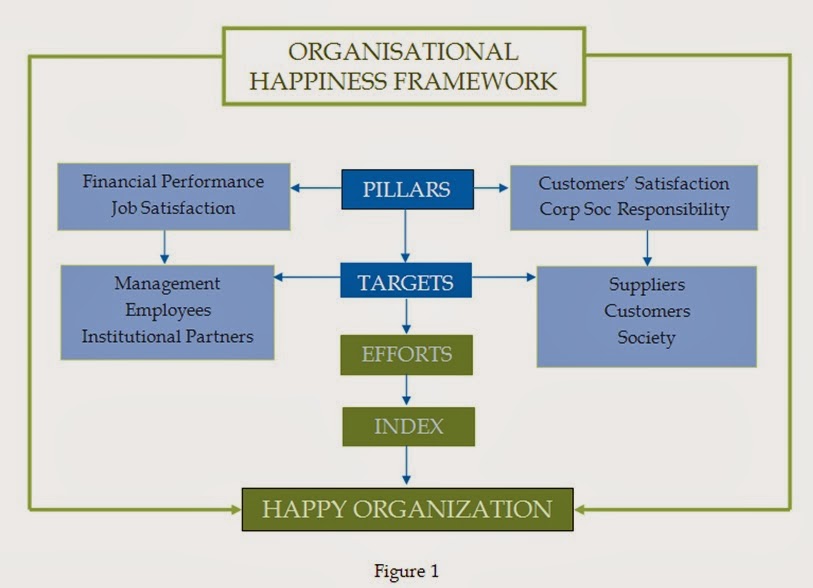
The existence of organization, big or small, state owned or privately owned, profit making or non-profit making, is initiated with some purpose in mind and in that direction objectives are outlined. The organizational activities are designed and the task to perform those activities is assigned to the employees or workers as the case may be. The performance is evaluated from the perspective of organizational objectives. During the course of its operation, the organization at times faces competition from other organizations or with past performance or with situation. These forces of competition compel the organization to draft winning strategies so that each one of them can perform better than the other. And this is what keeps an organization on toes and organizations keep surviving like this for years. Just like human beings. The human life keep facing challenges, ups and downs throughout and this is what makes life interesting as well as worth living.  Individuals perform t...

Why do Organisations Fail???

Few weeks back I was being interviewed - 'So if you need to give one most important reason for corporate failures, what that would be', one of the interviewer asked.  Without even thinking for a minute, I responded - 'Greed'.  I could observe an accepting smile on his face.  True.  In fact we were talking about the whole case of Satyam and Maytas, the corporate governance issues, the cooking-up of the accounting books, overstated size of employees, etc etc. But after the interview was over, I wanted to ask myself whether it is only the Greed which is the cause of corporate failures or there are some more reasons.  I kept thinking of many reasons for the next week and thought of again going through the book by Jim Collins 'How the Mighty Fall' with the notes of 'Good to Great' as well as 'Built to Last'.  Apart from this browsing through some old magazines and searching out the failure stories (quite unconventional, generally people prefer goin...