Posts

Showing posts with the label Leadership

WHAT MAKES A GOOD LEADER?
Image
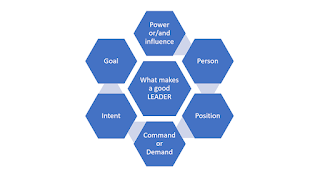
Leaders are there because there are followers. Leadership cannot be understood in isolation of followership. It is the followers who make a leader. Self-styled leadership lasts for a very short time, till the followers are ignorant. It is temporary. Such leadership is imposed and there are subordinates following the leader out of compulsion or in absence of any choice. However, when followers make a leader, when they elect or nominate a leader, such leaders are remembered for their ability to lead. When one amongst the team members is given the responsibility to lead the team, one cannot afford to ignore the team members, their interest, their abilities, their competencies and their drive to work towards the larger cause of achieving organizational goal. The team leader has to invest on enhancing capabilities of the team members and on building trust among team members. The leaders who resort to pick and choose, divide and rule, ignite and ignore, without any reason or rhyme, just...

COVID-19: Humanity and Human Well-Being beyond GDP

Image
The world is witnessing one of the worst pandemic of last one hundred years.  In one or the other way all citizens of the world are affected by this catastrophic occurrence causing huge losses of human lives viz-a-viz conditions of living.  The so called first world is the worst hit so far.  On March 22, 2020, the Indian Prime Minister, Narendra Modi announced 21-day lockdown to be effective from midnight.  He was able to read the signals and looking at the size of the population and the kind of health infrastructure that is required to deal with such a menace, this declaration was timely and needed.  On March 26, 2020, the King of Saudi Arabia convened an extraordinary virtual session of G20 nations where all the leaders expressed their concern over this grave global pandemic and agreed to develop a concrete action plan to fight together.  The Prime Minister of India , emphasized on putting the human beings at the centre of such planning for global pros...

WINNING TRUST: What the Man in the Mirror should do

All my friends in the discipline of commerce know SRCC as the premier commerce college of India. But for Charles Feltman SRCC meant differently. Sincerity, Reliability, Competence and Care are identified as four assessment criterion of trust. In the book titled The Thin Book of Trust , which was published around a decade back, Charles discusses his model of trust and provides practical solutions to avoid the enemies of trust around these four criterion. This model is timeless and helps one to build trust – a primary requisite for effective leadership - and lead a team of trustworthy people. Effective leaders create loyal and smart teams through winning the trust of team members which is duly reciprocated with an intent of concern and achieving organizational goal. Leaders go beyond rules and help making new rules. They cannot just afford to be manipulative and opportunistic and use others as sanitary pads. This may reap fruits for a very short period but otherwise it shall ruin th...

Leadership and Sports

Organizations have to chart out strategies in order to respond to competitive forces. Strategy is nothing but a game-plan. The intention is to put forth full potential and come out with flying colors and to win the game following the system, rules and procedures of the game. Competition is a prerequisite for strategy and in the VUCA times it has become further challenging to compete. The belief that competition is with the external forces drives the organization to target only external parties or rivals. Surprisingly organizations have to learn to manage the competition from within and with the situation with more rigor and responsibility. And that is where leadership becomes key. The whole science of game theory provide a guide to a leader to follow the principles of sports in order to make effective decision. The whole premise of team-building is built on the principles of work satisfaction. One enjoys doing what one does. It allows one to put across full strength to a...

On Ethical Leadership

Lexical semantics of ‘Ethical Leadership’ drives me to believe that the very activity of leading should be ethical. Ethics are generally accepted moral principles to be followed by individual/s. Leadership as such is a group activity but ethics have to be followed by individuals. The broader message that I get from these two words is that the leaders should follow moral principles and thereby expound their discourses through ethical practices. So ethics have an important role to play in the behavior of a leader and in the whole process of leadership. We need to look beyond just lexical semantics and explore as to the role of ethics in leadership. Success or failure of an organization depend on the person who leads it. It is a general belief that an organization has three types of people working for it - 10% belong to the category of hard working group (highly committed employees) and 10% belong to hardly working group (laid-back employees) and remaining 80% follow the leader (Co...

On Entrepreneurial Style of Leadership

Academia has always been differentiating a leader from a manager. And it is believed that a manager can transform himself/herself into a successful leader by learning the art of leadership and by developing those traits that a leader possesses. All business students and practicing managers have to deal with this dilemma often and to come to terms that ultimately if one has to manage affairs of business successfully and produce expected results, one has to have a perspective of a leader. This is something which needs further elaboration for the cause of clarity and for the purpose of practice. The whole idea of leadership stems from the sense of followership. No follower, no leader. So it is the followers who make a leader. Honest intent for the cause, art of articulating the vision, winning attitude, guts to take risk and providing rock solid support to the followers are some such virtues which help one to put forth efforts to attain organizational goal. The vision has to be f...

ALERT that doesn’t make one a leader

A lot has been written on what makes one a great leader. I approach leadership from another angle. What does not make one a leader? It is an ALERT to be precise. A for Aloofness (as against friendly), L for Lawlessness or Lack of control (as against Systematic), E for Enigmatic (as against Clarity of purpose), R for Repetitive (as against Original or Innovative) and T for Timid (as against Confident). Leaders cannot afford to stay aloof from the people and purpose as they are expected to lead through their involvement, guidance and support at all levels. They need to portray friendly behavior in order to lead the team. Abiding law of the land is important as nobody and nothing is beyond law. Lawlessness does not just mean abiding by law, it also reflects on orderly structure and flow of things and activities as it drives measurable outflows. Absence of systematic planning and implementation takes away much of what a leader is expected in an organization which aspir...

Blue Ocean Entrepreneurship: an idea worth pursuing

Kim and Renee brought out the concept of Blue Ocean Strategy in 2004 through their research and writings and popularised it. That was related to the organizations that were trying to compete and were finding it difficult to sustain in the market full of related products and services and the pressures of the market in improving quality, reducing prices, designing well defended promotional schemes etc.  This is where BOS proposed to create a new market, develop a new product, convert noncustomers to customers, convey a new message, so that one does not feel the pressure of competition.  It was to kill competition and create a blue ocean where there is no competition.  And when in this blue ocean, competitors take birth, participate and compete and start hitting and eating your share it converts the blue ocean into red ocean.  This is the time one needs to come out of it and create another blue ocean. This strategy helped many companies to learn lessons and create blu...

Why do Organisations Fail???

Few weeks back I was being interviewed - 'So if you need to give one most important reason for corporate failures, what that would be', one of the interviewer asked.  Without even thinking for a minute, I responded - 'Greed'.  I could observe an accepting smile on his face.  True.  In fact we were talking about the whole case of Satyam and Maytas, the corporate governance issues, the cooking-up of the accounting books, overstated size of employees, etc etc. But after the interview was over, I wanted to ask myself whether it is only the Greed which is the cause of corporate failures or there are some more reasons.  I kept thinking of many reasons for the next week and thought of again going through the book by Jim Collins 'How the Mighty Fall' with the notes of 'Good to Great' as well as 'Built to Last'.  Apart from this browsing through some old magazines and searching out the failure stories (quite unconventional, generally people prefer goin...